In the United States, a ballot measure is a law, issue, or question that appears on a statewide or local ballot for voters of the jurisdiction to decide.
This page provides an overview of the different types of ballot measures in the U.S., which can be (a) placed on the ballot through citizen initiative petitions; (b) referred to the ballot by the state legislature or local government body; or (c) automatically placed on the ballot with no action from a legislature or governing body via a state law or constitutional provision requiring such a ballot measure.
Types of ballot measures
- Combined initiated amendment and statute
- Indirect initiated constitutional amendment
- Indirect initiated state statute
- Initiated constitutional amendment
- Initiated state statute
- Veto referendum
Legislatively referred measures:
- Legislatively referred constitutional amendment
- Legislatively referred state statute
- Legislatively referred bond question
Other:
- Advisory question (nonbinding; does not result in a new, changed, or repealed law or constitutional provision)
- Automatic ballot referral (not initiated or referred; automatically set to appear on the ballot)
- Commission referral (referred by commission, not legislature)
- Convention referred constitutional amendment (referred by constitutional convention, not legislature)
Ballot measures in the United States
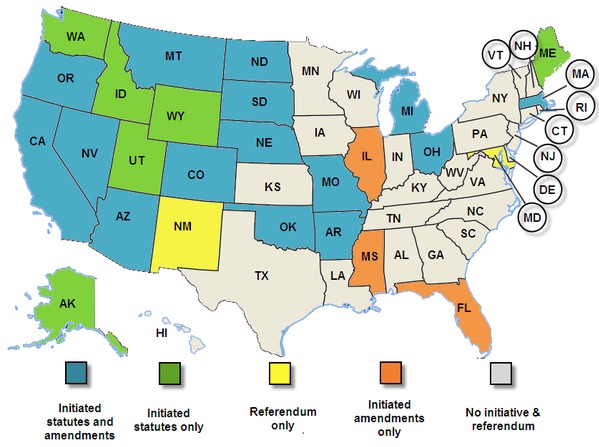
There have been statewide ballot measures in each of the 50 states. Citizens can collect signatures to place measures on the ballot in 26 states. Every state but Delaware requires voters to ratify proposed state constitutional amendments—changes to a state’s constitution. The following map illustrates which states provide for a ballot initiative or veto referendum process.
Citizen-initiated ballot measures
Citizens can collect signatures to place laws on the ballot in 26 states. There are various types of citizen-initiated ballot measures, which are outlined in the following sections.
Ballot initiatives may take the form of either the direct or indirect initiative. Under the direct initiative, a measure is put directly to a vote after enough signatures are submitted. Under the indirect initiative, a measure is first referred to the state legislature, and then only put to a popular vote if not enacted by the legislature.
Initiated amendment
An initiated constitutional amendment is a citizen-initiated ballot measure that amends the state constitution. Of the 26 states that provide some form of initiative, 18 states allow for citizens to initiate constitutional amendments.
In Massachusetts and Mississippi, the initiated constitutional amendment is indirect, meaning the proposal goes to the legislature before going to voters. In Massachusetts, the legislature must approve the constitutional amendment for the measure to appear on the ballot. In Mississippi, the legislature’s action does not affect whether or not the measure appears on the ballot; however, the Mississippi State Legislature is given the option to provide a competing measure alongside the citizen-initiated one.
In Nevada, a citizen-initiated constitutional amendment must be voted on and approved at two successive general elections to become part of the state constitution.
To read about the different requirements for constitutional amendments in various states, click here.
Initiated statute
An initiated state statute is a citizen-initiated ballot measure that amends state statute. Of the 26 states that provide some form of initiative, 21 states allow for citizens to initiate state statutes.
Seven of the 21 states provide for indirect, but not direct, citizen-initiated state statutes. An indirect initiated state statute goes to the legislature after a successful signature drive. The legislatures in these states have the option of approving the initiative themselves, rather than the initiative appearing on the ballot. In Utah and Washington, citizens can use either a direct or indirect initiated state statute.
Combined initiated amendment and statute
In California and Colorado, citizens have the option of initiating a combined constitutional amendment and state statute. The ballot measure is allowed to contain constitutional and statutory provisions that are related to a single subject.
Veto referendum
A veto referendum is a type of citizen-initiated ballot measure that asks voters whether to uphold or repeal a law that was passed by the state legislature. Of the 26 states that provide some form of initiative, 23 states allow for citizens to initiate veto referendums. In Maryland and New Mexico, the only form of citizen initiative available to residents are veto referendums.
Statute affirmation (Nevada)
In Nevada, voters have the power to initiate a statute affirmation. Like a veto referendum, a statute affirmation places a law that was already passed on the ballot. Passage of a statute affirmation prohibits the legislature from amending the law without voter approval.
Local citizen-initiated measures
There are local ballot measure analogs to the types of measures outlined above.
- A citizen-initiated charter amendment is analogous to a citizen-initiated constitutional amendment.
- A citizen-initiated ordinance is analogous to a citizen-initiated state statute.
- A veto referendum of an ordinance is analogous to state statute veto referendums.
Legislative referrals
The legislatures of each state have the power to refer measures to the ballot.
Referred amendment
Every state but Delaware requires voters to ratify proposed state constitutional amendments—changes to a state’s constitution—at a statewide election. The main differences in the requirements for a legislature to refer a constitutional amendment are (a) the number of times that the legislature must vote on the amendment and (b) the size of the legislative vote.
Referred statute
Legislatures have the option to refer statutes to the ballot as well. There are types of statutes that are often required to appear on the ballot in some states, such as tax increases (specifically in Colorado under the Taxpayer’s Bill of Rights) and bond issues.
In Arizona and California, bills that would amend voter-approved initiatives must be referred to the ballot. In Montana, the legislature can refer a statute to the ballot without the governor’s signature.
Local referrals
At the local level, most government types can refer questions to voters. Many involve tax, bond, or revenue questions as required by state law. Referrals are most often sent to the ballot by the following government entities:
- city/town councils
- county boards
- school boards
- special district boards
- Local Agency Formation Commissions
Other
Advisory question
An advisory question is a type of ballot measure in which citizens vote on a non-binding question. The difference between an advisory vote and any other type of ballot measure is that the outcome of the advisory question will not result in a new, changed, repealed, or rejected law or constitutional amendment. Rather, advisory questions allow voters to voice their preference and allow the state legislature or local government to gauge public opinion on the issue being presented.
Commission referrals
There are several state commissions that have the power to refer measures to the ballot. In Florida, the Constitution Revision Commission and Taxation and Budget Reform Commission, which convene every 20 years, can refer constitutional amendments to the ballot. In Arizona, the Commission on Salaries for Elective State Officers can refer to statutes addressing salaries for elected officials.
Automatic referrals
An automatic ballot referral is a ballot measure that is set under state law or a state’s constitution to automatically appear as a statewide ballot question under certain circumstances. The most common types of automatic ballot referrals are Constitutional Convention questions. Constitutional convention ballot propositions are a form of automatic ballot referral in some states whose constitutions state that every so often, a statewide ballot proposition must be placed on the general election ballot asking the voters of the state if they wish to have a constitutional convention. In fourteen states, the question of whether to hold a constitutional convention is automatically referred to a statewide ballot without any requirement for a vote of the state legislature to place the question on the ballot.
 The Native Party Trust